How Long Do Cut Flowers Last? A Complete Guide by Flower Type

You´ve just received a beautiful bouquet-or you´re about to send one. Either way, there´s one question that comes up every time: how long will these flowers actually last?
What is the average vase life of a bouquet?
The answer depends heavily on the type of flower, how fresh it was when cut, how it was shipped, and how you care for it once it's in the vase. This guide breaks down the vase life for every major cut flower variety, explains exactly what shortens or extends that life, and gives you concrete, tested care tips that can add days - sometimes a full week - to any arrangement.
The bottom line upfront: most cut flowers last 5–12 days. Farm-fresh flowers that haven´t spent days in a warehouse or at a florist shop can last up to two weeks or longer. The freshness at the time of cutting is the single biggest factor - which is why farm-direct delivery makes a meaningful difference.
Cut Flower Vase Life: Quick Reference Table
Use this table as a fast reference, then read the section for your specific flower below for detailed care instructions.
What is the average vase life of a bouquet?
The answer depends heavily on the type of flower, how fresh it was when cut, how it was shipped, and how you care for it once it's in the vase. This guide breaks down the vase life for every major cut flower variety, explains exactly what shortens or extends that life, and gives you concrete, tested care tips that can add days - sometimes a full week - to any arrangement.
The bottom line upfront: most cut flowers last 5–12 days. Farm-fresh flowers that haven´t spent days in a warehouse or at a florist shop can last up to two weeks or longer. The freshness at the time of cutting is the single biggest factor - which is why farm-direct delivery makes a meaningful difference.
Cut Flower Vase Life: Quick Reference Table
Use this table as a fast reference, then read the section for your specific flower below for detailed care instructions.
| Flower Type | Average Vase Life | Key Care Factor | Pro Tips for Maximum Bloom |
|---|---|---|---|
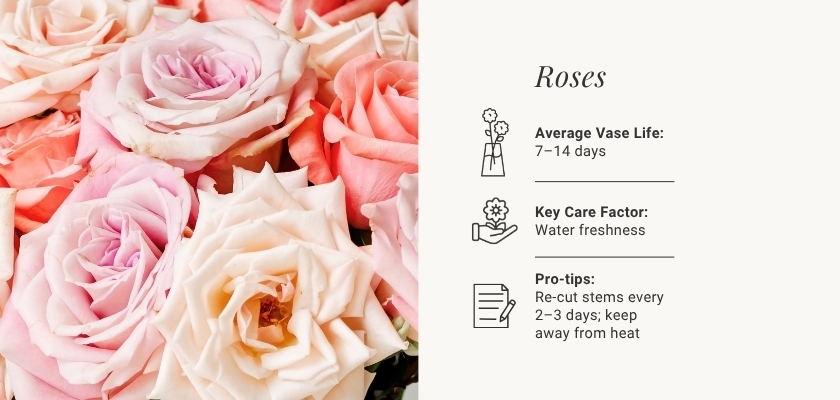
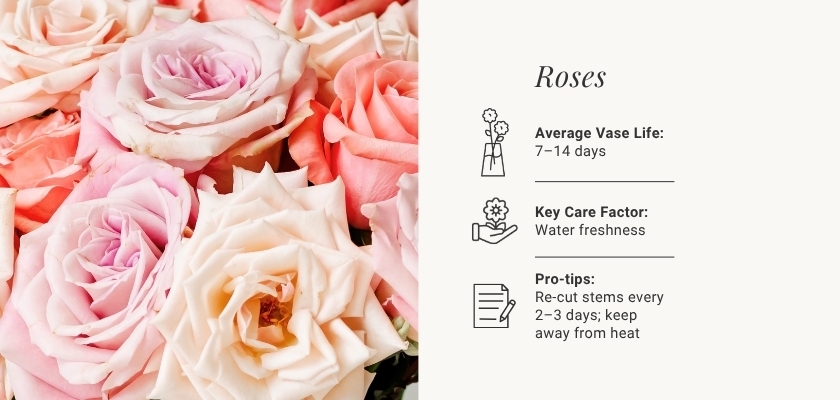
| Roses | 7–14 days | Water freshness | Re-cut stems every 2–3 days; keep away from heat |
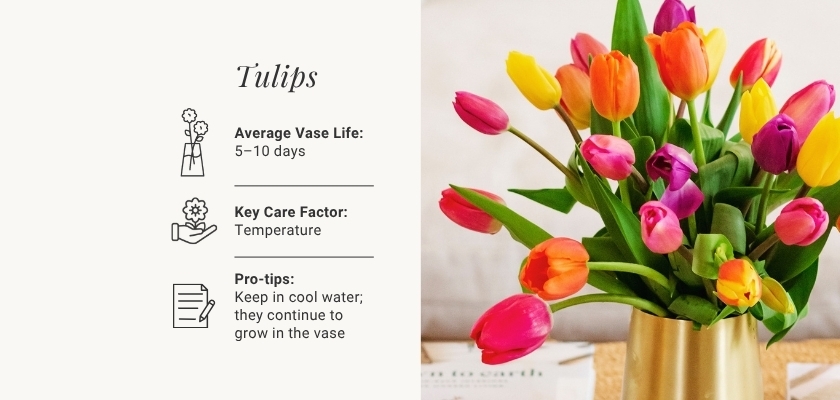
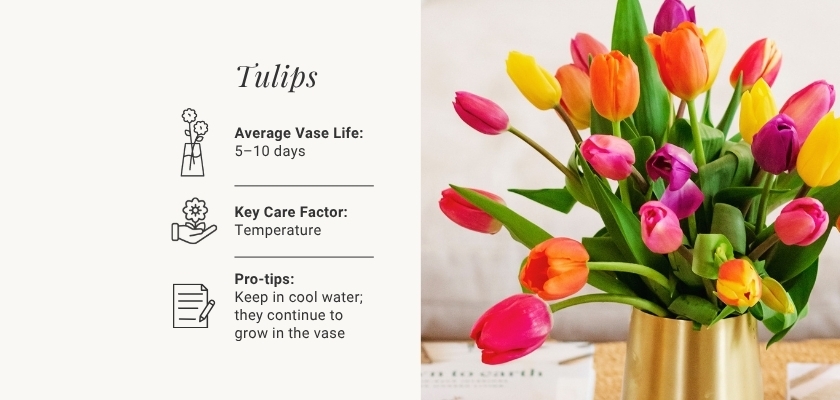
| Tulips | 5–10 days | Temperature | Keep in cool water; they continue to grow in the vase |
| Peonies | 5–7 days (up to 10 if fresh) | Stage at cutting | Buy/receive in bud form for the longest life |
| Lilies | 7–14 days | Stamen removal | Remove stamens immediately to prevent petal staining |
| Sunflowers | 6–12 days | Stem conditioning | Sear stem ends or use flower food; avoid cold water |
| Hydrangeas | 5–10 days | Hydration method | Submerge entire head in water to revive if wilting |
| Ranunculus | 7–10 days | Coolness | One of the most heat-sensitive cut flowers; keep very cool |
| Gerbera Daisies | 7–14 days | Stem length in water | Short stems in shallow water; straight stems prevent bending |
| Carnations | 14–21 days | Bacterial prevention | Replace water every day; very long-lasting if kept clean |
| Alstroemeria | 10–14 days | Leaf removal | Strip all leaves below waterline; very hardy variety |
| Freesia | 7–10 days | Bud count | Open buds from the bottom up; fragrant and long-lasting |
| Orchids (Dendrobium) | 14–21 days | Minimal water | Use a very small amount of water; never let sit in standing water |
| Snapdragons | 7–10 days | Vertical storage | Store upright or they'll curve toward light |
| Stock | 7–10 days | Clean water | Particularly prone to bacteria; change water daily |
| Lisianthus | 10–14 days | Fresh cut | Lasts remarkably long with proper care; cut every 2 days |
| Chrysanthemums | 14–21 days | Conditioning | Remove lower leaves; one of the hardiest cut flowers |
| Iris | 3–7 days | Bud stage | Receive in tight bud form — open quickly, enjoy fully |
| Daffodils / Narcissus | 5–7 days | Isolation | Keep separate from other flowers (their sap is harmful to roses) |
| Baby’s Breath (Gypsophila) | 5–14 days | Air drying | Can be dried upside down and will last indefinitely |
| Calla Lilies | 7–10 days | Upright storage | Store vertically; the stem is delicate and bends easily |
| Flower Type | Average Vase Life | Key Care Factor | Pro Tips for Maximum Bloom |
|---|---|---|---|
| Roses | 7–14 days | Water freshness | Re-cut stems every 2–3 days; keep away from heat |
| Tulips | 5–10 days | Temperature | Keep in cool water; they continue to grow in the vase |
| Peonies | 5–7 days (up to 10 if fresh) | Stage at cutting | Buy/receive in bud form for the longest life |
| Lilies | 7–14 days | Stamen removal | Remove stamens immediately to prevent petal staining |
| Sunflowers | 6–12 days | Stem conditioning | Sear stem ends or use flower food; avoid cold water |
| Hydrangeas | 5–10 days | Hydration method | Submerge entire head in water to revive if wilting |
| Ranunculus | 7–10 days | Coolness | One of the most heat-sensitive cut flowers; keep very cool |
| Gerbera Daisies | 7–14 days | Stem length in water | Short stems in shallow water; straight stems prevent bending |
| Carnations | 14–21 days | Bacterial prevention | Replace water every day; very long-lasting if kept clean |
| Alstroemeria | 10–14 days | Leaf removal | Strip all leaves below waterline; very hardy variety |
| Freesia | 7–10 days | Bud count | Open buds from the bottom up; fragrant and long-lasting |
| Orchids (Dendrobium) | 14–21 days | Minimal water | Use a very small amount of water; never let sit in standing water |
| Snapdragons | 7–10 days | Vertical storage | Store upright or they'll curve toward light |
| Stock | 7–10 days | Clean water | Particularly prone to bacteria; change water daily |
| Lisianthus | 10–14 days | Fresh cut | Lasts remarkably long with proper care; cut every 2 days |
| Chrysanthemums | 14–21 days | Conditioning | Remove lower leaves; one of the hardiest cut flowers |
| Iris | 3–7 days | Bud stage | Receive in tight bud form — open quickly, enjoy fully |
| Daffodils / Narcissus | 5–7 days | Isolation | Keep separate from other flowers (their sap is harmful to roses) |
| Baby’s Breath (Gypsophila) | 5–14 days | Air drying | Can be dried upside down and will last indefinitely |
| Calla Lilies | 7–10 days | Upright storage | Store vertically; the stem is delicate and bends easily |
How Long Do Roses Last?
How Long Do Roses Last?
Average vase life
7–14 days (longer with farm-fresh stems) Roses are the most commonly gifted cut flower in the world, and their care is something most people think they understand — but get slightly wrong. The difference between roses that last a
week and roses that last two weeks usually comes down to just a few practices.
Why Freshness Matters More Than Anything
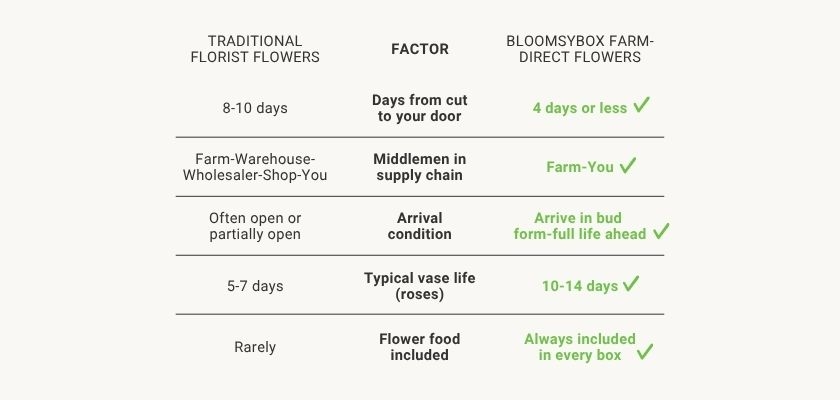
A rose that has been cut for 5 days before it reaches you has already used a significant portion of its vase life. This is the core issue with supermarket and traditional florist roses: by the time they travel from farm to warehouse to wholesaler to shop to your home, 8–10 days may have already passed.
BloomsyBox roses ship directly from farms in Colombia and Ecuador to your door in 4 days.
They arrive in bud form - meaning they have their full bloom life ahead of them. This is why farm-direct roses consistently outlast grocery store roses by several days.
Rose Care Tips That Actually Work
• Re-cut stems at a 45-degree angle immediately before placing in water - every time
you change the water.
• Change vase water every 2–3 days, or whenever it looks cloudy.
• Remove all leaves that would fall below the waterline - submerged leaves create
bacteria rapidly.
• Keep roses away from direct sunlight, heating vents, and fruit bowls (ripening fruit
releases ethylene gas, which accelerates wilting).
• Add flower food (included with all BloomsyBox deliveries) - it contains sugar for
nutrition, a biocide to kill bacteria, and a pH adjuster.
• In hot weather, place the entire vase in the refrigerator overnight - roses thrive in cool temperatures.
Pro tip: The aspirin myth
You may have heard that dropping an aspirin in your vase water extends flower life. The
research on this is mixed at best. Flower food sachets are significantly more effective. If youdon´t have flower food, a small amount of bleach (a few drops) and a teaspoon of sugar is a more reliable substitute.
Average vase life
7–14 days (longer with farm-fresh stems) Roses are the most commonly gifted cut flower in the world, and their care is something most people think they understand — but get slightly wrong. The difference between roses that last a
week and roses that last two weeks usually comes down to just a few practices.
Why Freshness Matters More Than Anything
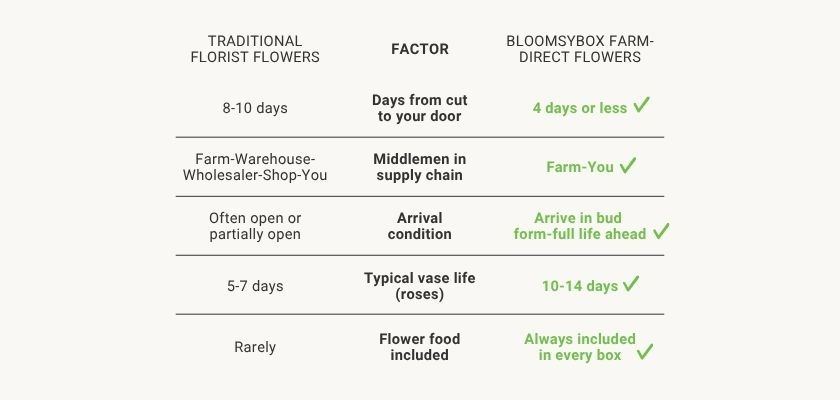
A rose that has been cut for 5 days before it reaches you has already used a significant portion of its vase life. This is the core issue with supermarket and traditional florist roses: by the time they travel from farm to warehouse to wholesaler to shop to your home, 8–10 days may have already passed.
BloomsyBox roses ship directly from farms in Colombia and Ecuador to your door in 4 days.
They arrive in bud form - meaning they have their full bloom life ahead of them. This is why farm-direct roses consistently outlast grocery store roses by several days.
Rose Care Tips That Actually Work
• Re-cut stems at a 45-degree angle immediately before placing in water - every time
you change the water.
• Change vase water every 2–3 days, or whenever it looks cloudy.
• Remove all leaves that would fall below the waterline - submerged leaves create
bacteria rapidly.
• Keep roses away from direct sunlight, heating vents, and fruit bowls (ripening fruit
releases ethylene gas, which accelerates wilting).
• Add flower food (included with all BloomsyBox deliveries) - it contains sugar for
nutrition, a biocide to kill bacteria, and a pH adjuster.
• In hot weather, place the entire vase in the refrigerator overnight - roses thrive in cool temperatures.
Pro tip: The aspirin myth
You may have heard that dropping an aspirin in your vase water extends flower life. The
research on this is mixed at best. Flower food sachets are significantly more effective. If youdon´t have flower food, a small amount of bleach (a few drops) and a teaspoon of sugar is a more reliable substitute.


How Long Do Tulips Last?
How Long Do Tulips Last?
Average vase life
5–10 days
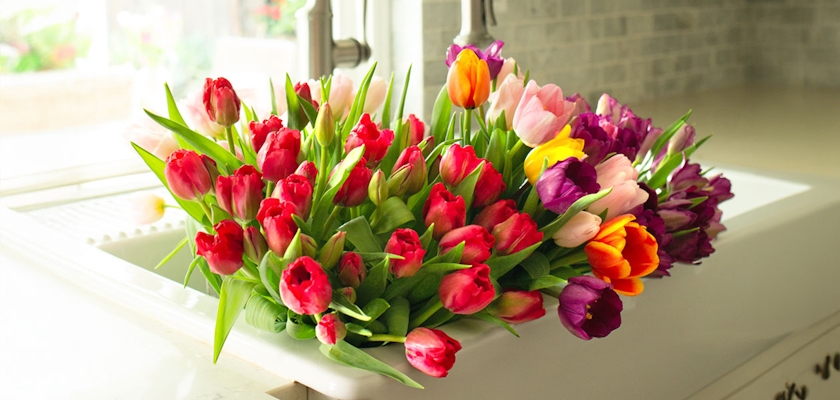
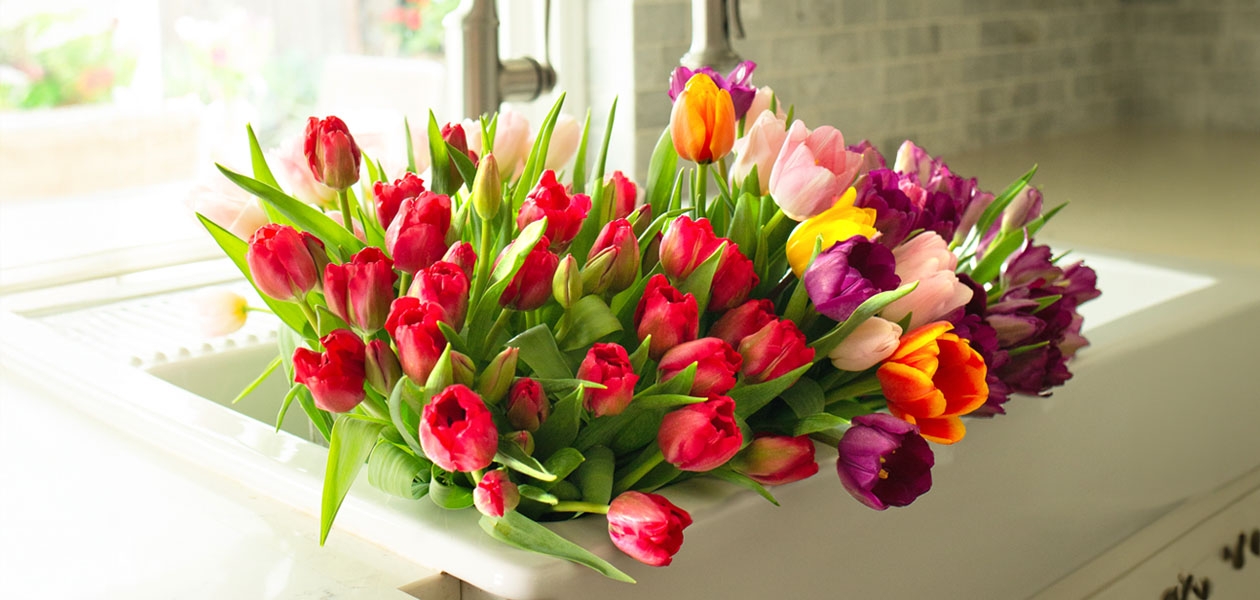
Tulips are one of spring´s most beloved flowers - but they have a quirk that surprises most people: they keep growing after they're cut. A tulip placed in a vase will continue to stretch upward and its petals will continue to open and move over its lifespan. This makes them dynamic and beautiful to watch, but it also means their care is slightly different from other cut flowers.
Tulip Care Tips
• Use cold or room-temperature water — avoid warm water, which accelerates blooming
and shortens vase life.
• Tulips are phototropic - they bend toward light, which can make a vase look uneven.
Rotate the vase regularly for upright stems.
• Keep in a cool room; refrigerate overnight if possible.
• Re-cut stems every 2 days - tulip stems absorb water through a wider surface area
than most flowers.
• Avoid mixing with daffodils - daffodil sap is toxic to tulips.


How Long Do Peonies Last?
How Long Do Peonies Last?
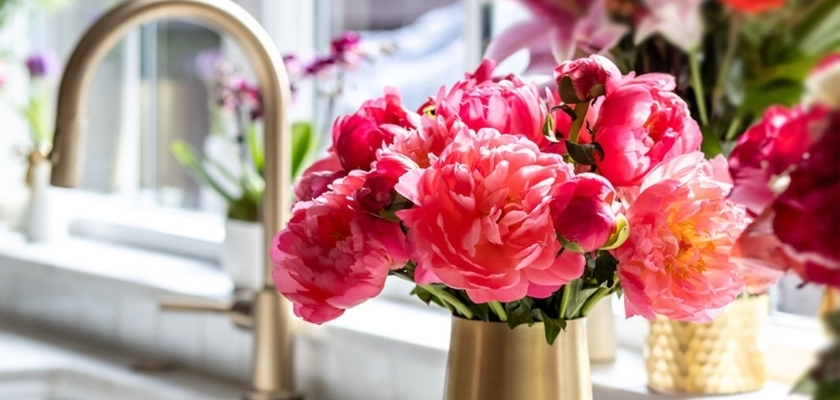
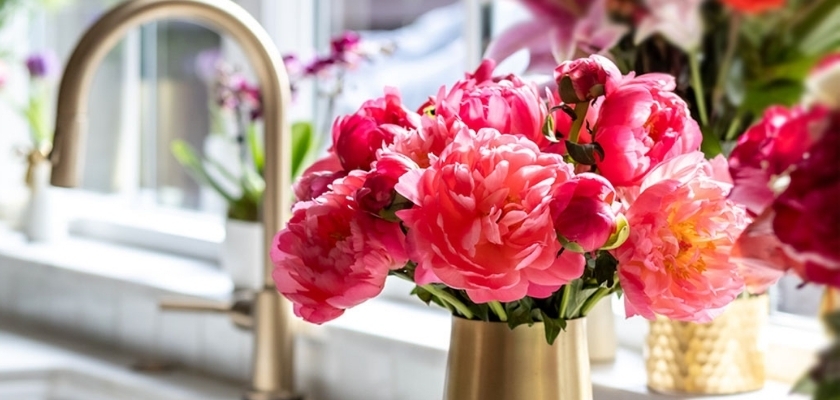
Average vase life
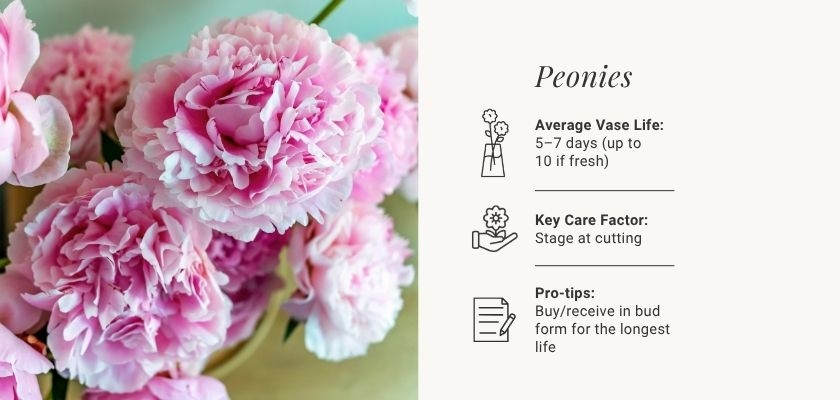
5–7 days open / up to 10 in tight bud form
Peonies are among the most treasured and short-lived of all cut flowers - which is part of what makes them so special. Their lifespan is highly dependent on the stage at which they are cut. A peony received in tight bud form will take several days to open fully, giving you the beautiful experience of watching it bloom and extending your enjoyment considerably. A peony received already fully open may last only 3–4 days.
Peony Care Tips
• If you receive peonies in tight bud form and want to delay blooming, keep them in a cool room or refrigerator wrapped in paper (not plastic).
• To encourage a tight bud to open faster, place in warm water in a warmer room.
• Change water daily - peonies are particularly sensitive to bacteria.
• Remove the guard petals (the tough outer petals) to encourage the inner petals to open
beautifully.
• Peonies are extremely fragrant when open - keep in a well-ventilated space if
fragrance-sensitive people are nearby.
Average vase life
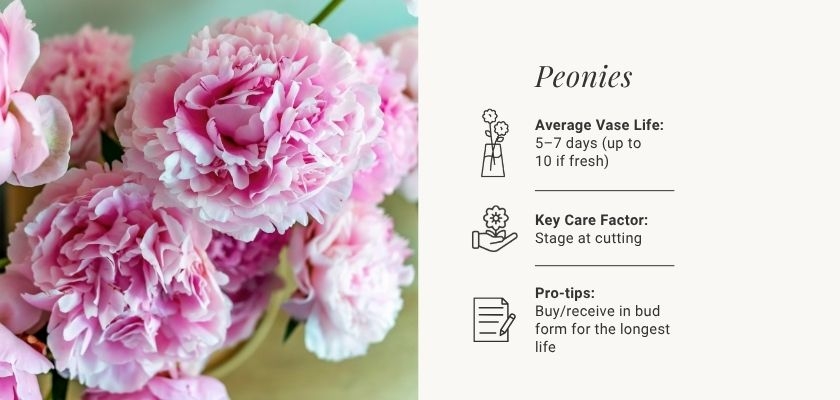
5–7 days open / up to 10 in tight bud form
Peonies are among the most treasured and short-lived of all cut flowers - which is part of what makes them so special. Their lifespan is highly dependent on the stage at which they are cut. A peony received in tight bud form will take several days to open fully, giving you the beautiful experience of watching it bloom and extending your enjoyment considerably. A peony received already fully open may last only 3–4 days.
Peony Care Tips
• If you receive peonies in tight bud form and want to delay blooming, keep them in a cool room or refrigerator wrapped in paper (not plastic).
• To encourage a tight bud to open faster, place in warm water in a warmer room.
• Change water daily - peonies are particularly sensitive to bacteria.
• Remove the guard petals (the tough outer petals) to encourage the inner petals to open
beautifully.
• Peonies are extremely fragrant when open - keep in a well-ventilated space if
fragrance-sensitive people are nearby.
How Long Do Sunflowers Last?
How Long Do Sunflowers Last?
Average vase life
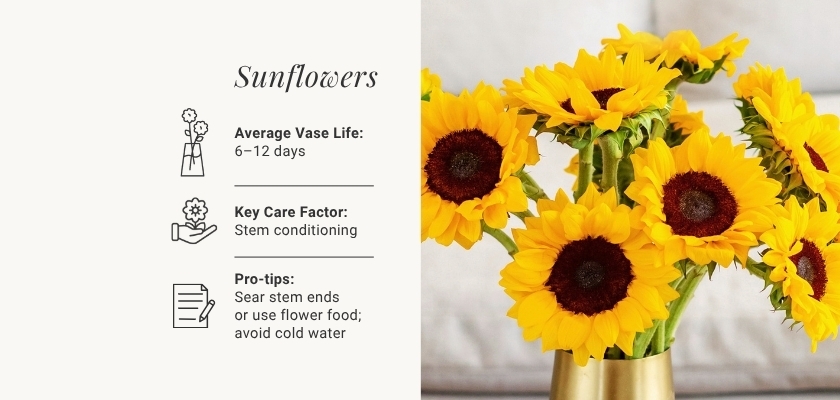
6–12 days
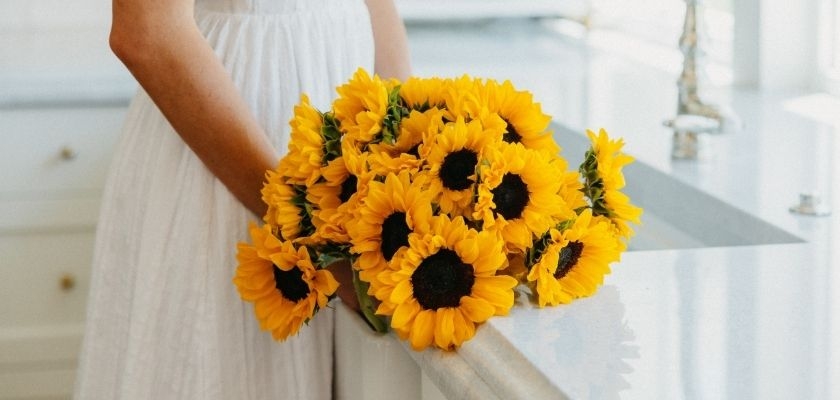
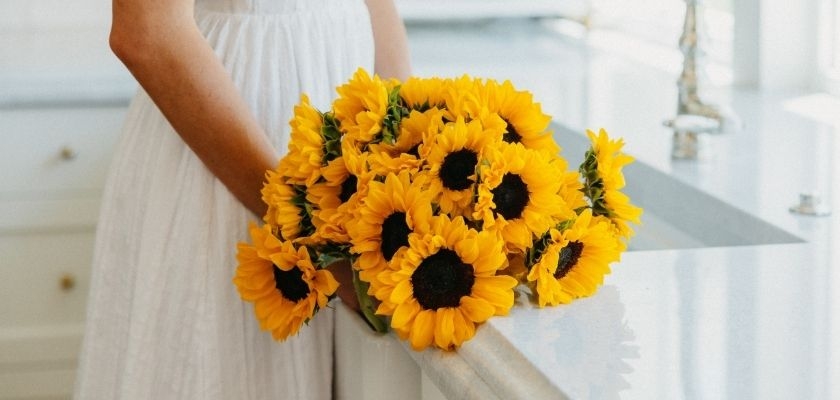
Sunflowers are hearty, cheerful, and surprisingly thirsty. They are heavy drinkers — a vase of sunflowers can go through water remarkably quickly — and they need to be conditioned properly to last their full potential.
Sunflower Care Tips
• The moment you receive sunflowers, cut 1–2 inches off the stems at a sharp diagonal
and immediately place in water — don't let the cut ends dry out for even a minute.
• Use a deep vase - sunflowers need substantial water access and their heads are
heavy.
• Keep away from direct sunlight, which causes rapid petal wilting despite the flower´s appearance.
• Remove lower leaves aggressively - submerged foliage decays quickly in sunflower
arrangements.
• Flower food is particularly effective with sunflowers - use it consistently.
Average vase life
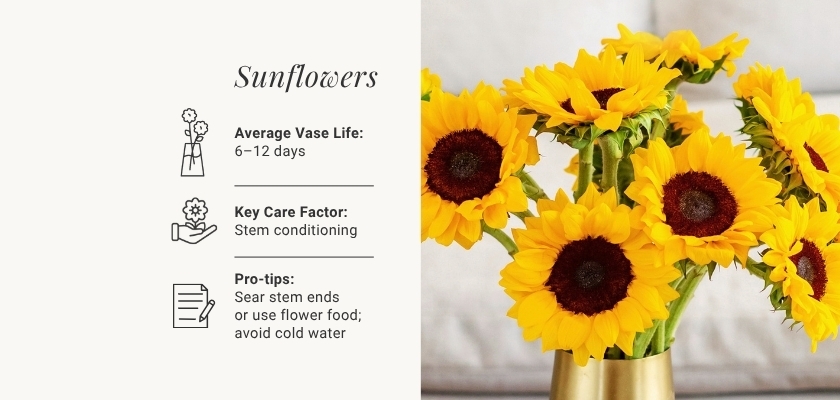
6–12 days
Sunflowers are hearty, cheerful, and surprisingly thirsty. They are heavy drinkers — a vase of sunflowers can go through water remarkably quickly — and they need to be conditioned properly to last their full potential.
Sunflower Care Tips
• The moment you receive sunflowers, cut 1–2 inches off the stems at a sharp diagonal
and immediately place in water — don't let the cut ends dry out for even a minute.
• Use a deep vase - sunflowers need substantial water access and their heads are
heavy.
• Keep away from direct sunlight, which causes rapid petal wilting despite the flower´s appearance.
• Remove lower leaves aggressively - submerged foliage decays quickly in sunflower
arrangements.
• Flower food is particularly effective with sunflowers - use it consistently.
How Long Do Hydrangeas Last?
How Long Do Hydrangeas Last?
Average vase life
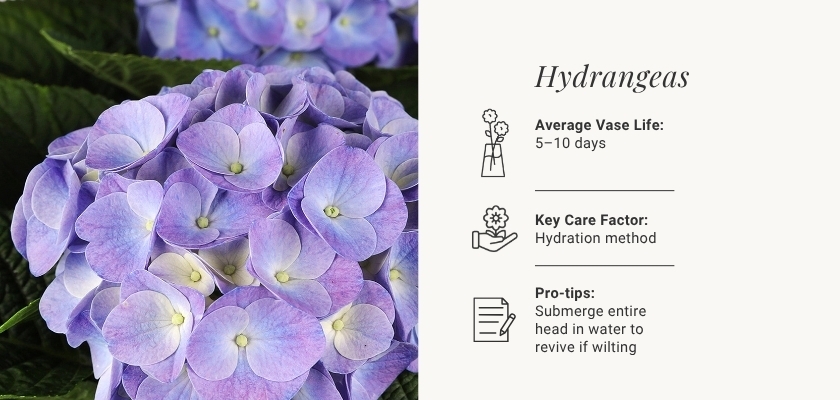
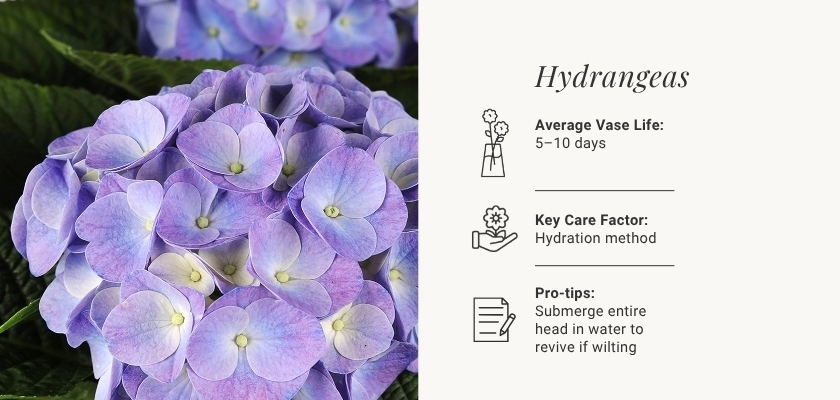
5–10 days
Hydrangeas are stunning in arrangements but have a reputation for wilting dramatically -
sometimes within hours of being placed in a vase. This wilting is almost always caused by one of two things: insufficient water absorption or air trapped in the stem. Both are easily fixed.
Hydrangea Care Tips - Including the Revival Technique
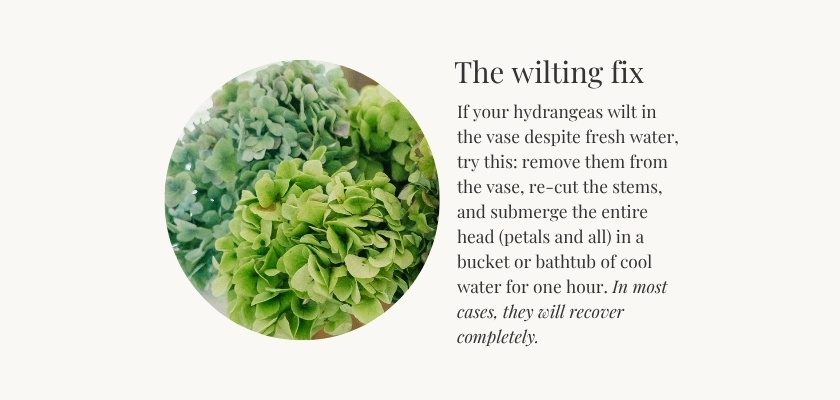
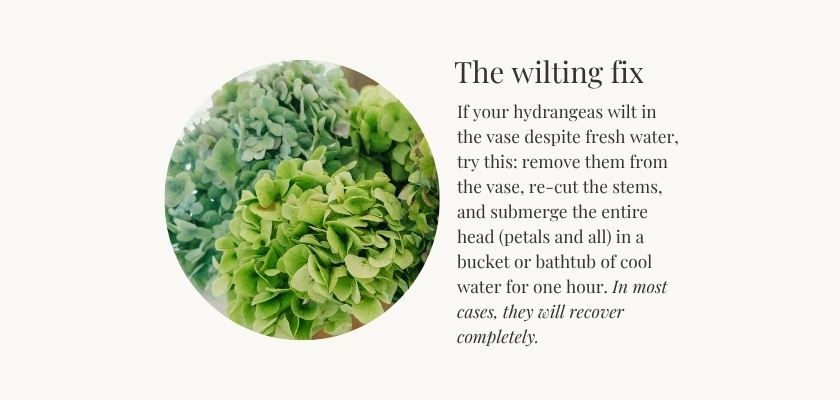
• When stems are placed in water, hydrangeas absorb water through both their stems
AND their flower heads. If a hydrangea is wilting, submerge the entire head in cool water
for 30-60 minutes - this almost always revives it.
• Cut hydrangea stems at a sharp angle and score (split) the bottom inch of the stem to
increase water absorption.
• Use a wide-mouthed vase with enough water to cover a significant portion of the stem.
• Change water every 1-2 days.
• Avoid placing hydrangeas near air conditioning vents - dry air dehydrates them rapidly.
Average vase life
5–10 days
Hydrangeas are stunning in arrangements but have a reputation for wilting dramatically -
sometimes within hours of being placed in a vase. This wilting is almost always caused by one of two things: insufficient water absorption or air trapped in the stem. Both are easily fixed.
Hydrangea Care Tips - Including the Revival Technique
• When stems are placed in water, hydrangeas absorb water through both their stems
AND their flower heads. If a hydrangea is wilting, submerge the entire head in cool water
for 30-60 minutes - this almost always revives it.
• Cut hydrangea stems at a sharp angle and score (split) the bottom inch of the stem to
increase water absorption.
• Use a wide-mouthed vase with enough water to cover a significant portion of the stem.
• Change water every 1-2 days.
• Avoid placing hydrangeas near air conditioning vents - dry air dehydrates them rapidly.


How to Make Any Cut Flowers Last Longer: The Master Guide
Regardless of the flower type, these practices apply universally and will extend the life of any arrangement:
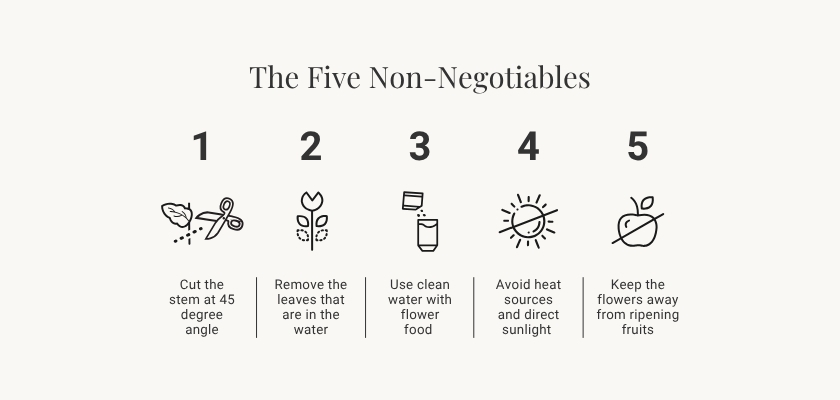
The Five Non-Negotiables
1. Re-cut the stems before placing in water. Use sharp scissors or a knife, cut at a 45-
degree angle, and do it under running water or submerged to prevent air bubbles. Air
pockets block water absorption.
2. Strip all leaves below the waterline. Submerged leaves decay and create bacteria that
clogs stem passages. Even a few leaves underwater will noticeably shorten the life of an
arrangement.
3. Use clean water with flower food. Change water every 2–3 days or when it becomes
cloudy. Rinse the vase each time with soap and water to remove bacterial buildup.
4. Keep flowers away from heat sources and direct sunlight. The single biggest accelerant
of wilting is heat. A spot on a cool counter away from windows and appliances is ideal.
5. Keep flowers away from ripening fruit. Bananas, apples, and other ripening fruit emit
ethylene gas, which triggers the natural aging process in flowers. A fruit bowl on the
same counter as your flowers will shorten their life measurably.
How to Make Any Cut Flowers Last Longer: The Master Guide
Regardless of the flower type, these practices apply universally and will extend the life of any arrangement:
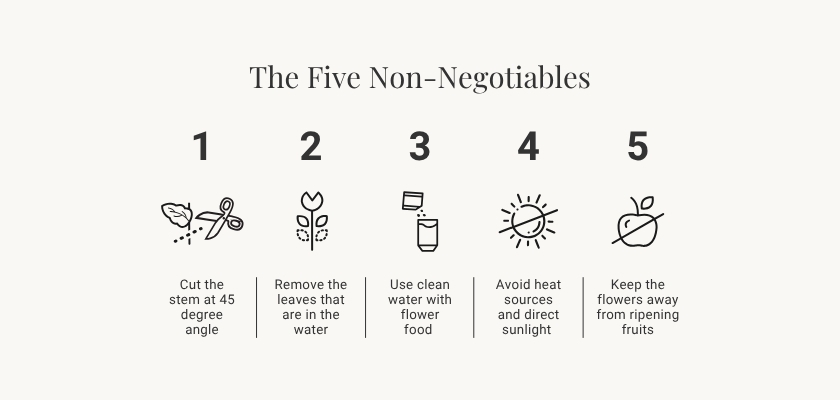
The Five Non-Negotiables
1. Re-cut the stems before placing in water. Use sharp scissors or a knife, cut at a 45-
degree angle, and do it under running water or submerged to prevent air bubbles. Air
pockets block water absorption.
2. Strip all leaves below the waterline. Submerged leaves decay and create bacteria that
clogs stem passages. Even a few leaves underwater will noticeably shorten the life of an
arrangement.
3. Use clean water with flower food. Change water every 2–3 days or when it becomes
cloudy. Rinse the vase each time with soap and water to remove bacterial buildup.
4. Keep flowers away from heat sources and direct sunlight. The single biggest accelerant
of wilting is heat. A spot on a cool counter away from windows and appliances is ideal.
5. Keep flowers away from ripening fruit. Bananas, apples, and other ripening fruit emit
ethylene gas, which triggers the natural aging process in flowers. A fruit bowl on the
same counter as your flowers will shorten their life measurably.
What to Do If Flowers Arrive Wilted
If flowers arrive looking limp or wilted after shipping, don't panic - this is normal and almost always reversible. Flowers lose water during shipping and often experience stress in transit.
Here´s the recovery process:
• Unpack immediately and cut 1–2 inches off all stems at a diagonal.
• Place in room-temperature water with flower food.
• Leave in a cool, dark place for 2–4 hours.
• For severely wilted flowers, fill the entire vase nearly to the top with cool water and allow stems to soak deeply.
Most flowers will recover completely within a few hours. BloomsyBox flowers are intentionally shipped in bud form, which means they arrive with their best days still ahead of them.
Why Farm-Fresh Flowers Last Significantly Longer
The biggest variable in cut flower lifespan is not what you do after the flowers arrive -it´s how fresh they were when they were cut. Here´s why this matters so much:
What to Do If Flowers Arrive Wilted
If flowers arrive looking limp or wilted after shipping, don't panic - this is normal and almost always reversible. Flowers lose water during shipping and often experience stress in transit.
Here´s the recovery process:
• Unpack immediately and cut 1–2 inches off all stems at a diagonal.
• Place in room-temperature water with flower food.
• Leave in a cool, dark place for 2–4 hours.
• For severely wilted flowers, fill the entire vase nearly to the top with cool water and allow stems to soak deeply.
Most flowers will recover completely within a few hours. BloomsyBox flowers are intentionally shipped in bud form, which means they arrive with their best days still ahead of them.
Why Farm-Fresh Flowers Last Significantly Longer
The biggest variable in cut flower lifespan is not what you do after the flowers arrive -it´s how fresh they were when they were cut. Here´s why this matters so much:
Frequently Asked Questions
Does keeping flowers in the refrigerator overnight help?
Yes - significantly. Florists store flowers in refrigerated coolers for exactly this reason. Cooler temperatures slow the bloom cycle, reduce water evaporation, and inhibit bacterial growth.
Placing your arrangement in the refrigerator overnight (or during the day when you're out) can add 2-4 days to the life of most flowers.
Should I add anything other than flower food to the water?
Flower food is the gold standard. If you don't have it, a small amount of bleach (2–3 drops per quart of water) combined with a teaspoon of sugar and a few drops of lemon juice is a reasonable substitute - the bleach kills bacteria, the sugar feeds the flowers, and the lemon juice adjusts pH. Commercial flower food, however, is specifically formulated to balance all three components and outperforms DIY solutions.
Can I revive wilted flowers?
Often yes. Re-cut the stems, place in warm water, and let them stand in a cool dark place for several hours. For dramatically wilted stems, wrap the entire bouquet tightly in newspaper to support the stems and submerge everything (stems and wrapped heads) in cool water for 1-2 hours. This technique - called "hardening" by florists - works well for roses, peonies, and hydrangeas especially.
Which flowers last the longest in a vase?
Carnations, chrysanthemums, orchids, and alstroemeria are the longest-lasting cut flowers - many can last 2–3 weeks with proper care. Chrysanthemums are particularly hardy and
forgiving. For shorter-lived but beautiful blooms, peonies and garden roses offer stunning displays for their briefer vase life.
Do flowers last longer in cold or warm water?
It depends on the flower and the situation. For initial hydration after cutting, warm water is absorbed more quickly. For ongoing vase water, cool or room temperature is preferred for most flowers. Bulb flowers like tulips and daffodils specifically prefer cold water throughout their vase life.
Frequently Asked Questions
Does keeping flowers in the refrigerator overnight help?
Yes - significantly. Florists store flowers in refrigerated coolers for exactly this reason. Cooler temperatures slow the bloom cycle, reduce water evaporation, and inhibit bacterial growth.
Placing your arrangement in the refrigerator overnight (or during the day when you're out) can add 2-4 days to the life of most flowers.
Should I add anything other than flower food to the water?
Flower food is the gold standard. If you don't have it, a small amount of bleach (2–3 drops per quart of water) combined with a teaspoon of sugar and a few drops of lemon juice is a reasonable substitute - the bleach kills bacteria, the sugar feeds the flowers, and the lemon juice adjusts pH. Commercial flower food, however, is specifically formulated to balance all three components and outperforms DIY solutions.
Can I revive wilted flowers?
Often yes. Re-cut the stems, place in warm water, and let them stand in a cool dark place for several hours. For dramatically wilted stems, wrap the entire bouquet tightly in newspaper to support the stems and submerge everything (stems and wrapped heads) in cool water for 1-2 hours. This technique - called "hardening" by florists - works well for roses, peonies, and hydrangeas especially.
Which flowers last the longest in a vase?
Carnations, chrysanthemums, orchids, and alstroemeria are the longest-lasting cut flowers - many can last 2–3 weeks with proper care. Chrysanthemums are particularly hardy and
forgiving. For shorter-lived but beautiful blooms, peonies and garden roses offer stunning displays for their briefer vase life.
Do flowers last longer in cold or warm water?
It depends on the flower and the situation. For initial hydration after cutting, warm water is absorbed more quickly. For ongoing vase water, cool or room temperature is preferred for most flowers. Bulb flowers like tulips and daffodils specifically prefer cold water throughout their vase life.
Want flowers that arrive in peak-fresh condition - and last?
BloomsyBox ships direct from Rainforest Alliance Certified farms to your door in 4 days. Every box includes flower food and a care guide.
Want flowers that arrive in peak-fresh condition - and last?
BloomsyBox ships direct from Rainforest Alliance Certified farms to your door in 4 days. Every box includes flower food and a care guide.
Subscriptions from $59.99 · Free shipping · Arrives in bud form for maximum freshness
Subscriptions from $59.99 · Free shipping · Arrives in bud form for maximum freshness